What is Imperialism, and How Did It Get to the Philippines?

Monopoly Capitalism

Imperialism is the highest stage of capitalism, the state of monopoly capitalism.  Simply put, it is comparable to a leech, whose only means of living is by feeding off of its host.  In reality, Imperialism, due to its crisis of overproduction, needs to depend on the sustenance of feudal and/ or semi-feudal countries such as the Philippines.


At the dawn of the 20th century, the United States has reached the highest stage of capitalism, wherein capital, banking and industry merged and reached a point of monopoly.  Due to this combination, it has dramatically raised its productive capacities, enabling it to produce more than enough commodities needed for domestic consumption.  As a by product, the crisis of overproduction came knocking on its doors.  This condition necessitated the United States to look for new markets, sources of cheap raw materials and surplus capital, and a cheap labor force beyond its borders.

Bonifacio leads the proletariat revolution of 1896

In 1898, the Philippines was on the verge of a revolutionary victory against the crumbling Spanish empire.  Led by the proletarian hero Andres Bonifacio, the Filipinos launched the first war of national liberation in Asia.  Through the Katipunan, an underground revolutionary movement, the young Filipino proletariat, in alliance with the farmers and intellectuals mobilized the Filipino masses to realize their national and democratic aspirations.

After buying the Philippines from Spain for twenty million dollars, the U.S. proceeded with its Imperialist conquest, which they called “benevolent assimilation”.  It immediately showed this so-called benevolence by replicating its genocidal campaign against the Native Americans, this time against the Filipino people.  Employing a hundred thousand troops and the most advanced military weaponry available, they murdered an estimated six hundred thousand Filipinos, combatants and non-combatants alike, in coldblood. On July 4, 1902, the U.S. government declared the war over but Filipino revolutionaries, alongside the masses of workers and peasants, continued the struggle for national liberation and democracy.

How Does U.S. Imperialism Operate in the Philippines?

Farmers work the fields at Hacienda Luisita

Figuratively speaking, the semi-feudal and semi-colonial character of Philippine society is the fertile soil from which imperialism draws its life.  The nation’s economy functions on an export-oriented, import-dependent approach that is forced to crouch down to the demands of U.S. Imperialist interest instead of responding to domestic needs.

Despite being an agricultural country, the grasp of feudal practices such as monopolization of land, exploitative working conditions for farmworkers, backward agricultural technology, and production aimed for export resulting in massive landlessness among the peasantry and the proletariat (which compose 90% of the population), joblessness, rising prices of basic (imported) commodities, and migration among the workers and the petty-bourgeoisie (4,500 Filipinos leave the country per day).

Imperialism boasts of its ability to control a state without physical presence; thus, it furthers its influence through economic, political and cultural means.  Long after the supposed use of military might in the name of democracy in the Philippines, the U.S. introduced and established the bastion for colonial mentality- the public school system. Its curriculum suppressed  nationalism by diluting the rich, revolutionary history of the Filipino people, imposing the use of English as the medium of instruction, and promoting Western culture.

Initially tailored to educate children of national bureaucrats, landlords, and business owners, state colleges and universities offered programs that trained and produced puppet leaders who ensure the perpetuation of U.S. domination in the form of policies consistently seen in every puppet regime since the Americans granted the Philippines nominal independence in 1946.  Such policies include, but are not limited to:

The disputed "Balikatan Exercises"

-Military agreements such as the Visiting Forces Agreement (VFA) that allow for the continued presence of American troops beyond the Military Bases Agreement which ended in 1991;

-Sham Agrarian reform programs, which ironically serve to concentrate agricultural lands in the hands of the Landlords and maintain the backward agriculture that is solely geared towards producing crops for export.

Operation Plan: Freedom Watch, counter-insurgency program 2002- 2009

-Counter-insurgency programs that are fully funded by the U.S. These aim to destroy the armed revolutionary movement in the Philippines, namely the Communist Party of the Philippines, New People’s Army and the National Democratic Front of the Philippines (CPP-NPA-NDFP). The latest among Counter-insurgency program is called Oplan Bayanihan, the implementation of the U.S. Counter Insurgency (COIN) Guide, the primary cause of human rights violations in the Philippines.

-one-sided Economic agreements, neo-liberal policies such as trade liberalization which opens up the economy to surplus goods and capital being dumped by the U.S., economic deregulation that produces super profits, partularly to Oil Cartels, privatization of basic social services and contractualization of labor to provide cheap labor for foreign monopoly capitalists.

Today, the colonial foundation of Philippine education manifests itself through the prevalence of privatized and semi-privatized schools determined to produce English-speaking teachers, nurses, engineers and other professionals to satisfy the needs of the global workforce, while industries shrivel and deteriorate at home.  Hand in hand with the Labor Export Policy, a government initiative to generate funds to keep the economy alive through billions of dollars in remittances each year, the semi-colonial character of Philippine society stunts the nation’s growth and impedes its path to national industrialization.

What Are the Filipinos Doing to Fight Imperialism?

Filipinos are generally described as happy and peace-loving people. They are known to be a nation of hospitable indigents, of hardworking service-oriented men and women. This is essentially true. They believe in social justice as a stepping stone for peace, and they work hard- -some even risk their lives– in advancing the struggle for genuine democracy.

NDFP peace panel chairman Luis Jalandoni

Anti-imperialist movements come in various forms. The first and longest running of which is the New Democratic Revolution being waged by the New People’s Army (NPA), under the leadership of the Communist Party of the Philippines (CPP) and its revolutionary united front, the National Democratic Front of the Philippines (NDFP). Last 2009, the CPP declared that it will aim to achieve, what it calls, the Strategic Stalemate of its protracted people’s war in 5 years. This worries U.S. Imperialism as the revolutionary forces threaten to crush its local reactionary puppets.

The second, in which Anakbayan (in English: “sons and daughters of the nation”) is part of, is the legal National Democratic mass movement across the country and abroad. Its aim is to fight for the basic rights of the Filipino in recognition of the fact that the country is controlled by a foreign entity, and will remain poor until it liberates itself from U.S. Imperialism.

National Democracy involves the advancement of a mass-oriented, scientific and patriotic culture by providing free, accessible and liberating education to all levels; upholding worker’s rights, raising the quality of life, and developing social services by way of genuine agrarian reform and strategic national industrialization; and adapting an independent foreign policy that is anti-imperialist, independent and peaceful. Its analysis of pressing issues such as budget cuts in education and other social services, oil price and fare hikes, U.S. wars, and human rights violations incorporates the relation of imperialism, bureaucrat capitalism and feudalism as the three basic problems in Philippine society.

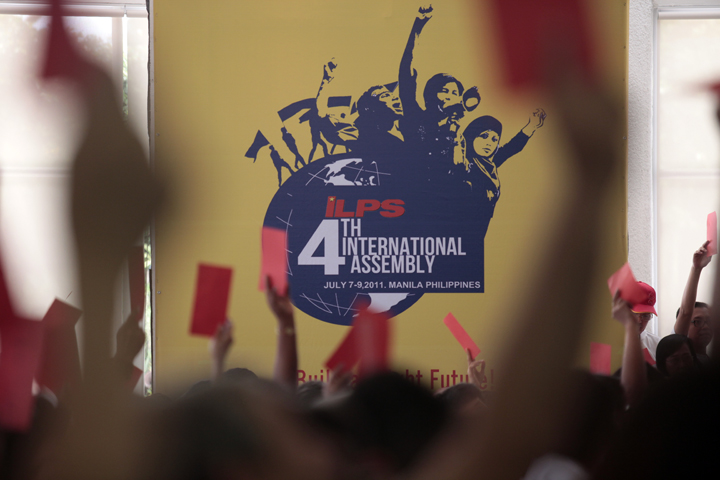
Participants of the 4th ILPS Assembly in Manila, July 2011

Finally, the International League of Peoples’ Struggle (ILPS) forms the united front for anti-imperialist and democratic struggles of workers, peasants, women, youth, professionals and other sectors of society around the world. The ILPS- USA chapter will hold its founding assembly on the third week of May 2012 in Seattle. Visit www.ilps-web.com for updates.


Why Americans Need to Stand Against Imperialism

US President Obama shakes hands with Philippine President Aquino

The current U.S. puppet, Benigno “Noynoy” Aquino III, is squandering the Filipino people’s money on senseless foreign debt servicing and fortification of the Armed Forces of the Philippines (AFP) in its U.S.-backed war against the armed resistance in the countryside without addressing the root cause of the conflict. His government, with assistance from the Obama administration, continues the cycle of indebtedness and state repression.

The U.S. granted approximately $28 million in military aid to the Philippines this year. This package includes financing, educating and training, and anti-terrorism schemes for the AFP, internationally notorious for over a thousand cases of torture, abductions, extra-judicial killings, illegal arrests, and other human rights atrocities within the past ten years.

Imperial U.S. maintains hegemony over much of the world’s resources and preserves its otherwise crumbling capitalist economy through war and occupation. At present, one can think of the developments in Libya, Iraq, Egypt and Afghanistan as its prospective hosts. In the same vein that the U.S. snatched the Philippine revolution’s victory over Spain in 1898, it is maneuvering and manipulating these territories into subservience to American products and ideals. Not surprisingly, the model of “defend, educate, rebuild, protect” that was successfully prototyped in the Philippines is now being used in these areas of imperialist interest.

U.S.- NATO Forces

To start off, the U.S. will help a country defend its people from a dictatorship by supporting the overthrow of an unpopular leader via “humanitarian intervention”. It then proceeds to “educate” the people into glorifying the U.S., mighty liberator and ally, as the state’s government and economy are revitalized by funds lent by the IMF-World Bank, rendering the weakened nation unwittingly buried in foreign debt. The local ruling class forge policies with the neo-colonizers to protect imperialist investments and promote colonial culture at the hands of a fascist government.

Our Next Steps

U.S. taxpayers should not subsidize the greed and ambition of monopoly capitalism. Instead, the trillions of dollars spent on war should be cut, and re-channeled as budget for social services like education, health care, housing, pension, etc. Building an anti-imperialist united front here in America is only possible if its citizens consciously link their domestic struggles to the global struggle against the reckless use of public resources for tyranny of one state over another.

AB-NJ with BAYAN and other allied orgs at the April 9th Anti-War Rally in NYC

Anakbayan New Jersey is inviting the youth, Filipino and non-Filipino, to: (1) work on joint campaigns to expose and oppose U.S. military presence and military aid in the Philippines and other semi-colonial countries; (2) participate in, and launch actions for, Philippine Solidarity Week in February; and (3) join the International League of Peoples’ Struggle.

Chinese revolutionary, Mao Zedong, once said, “Imperialism is nothing but a paper tiger”. By strengthening our ranks with critical education, solid organization,and collective mobilizations, we garner little victories toward loosening the intimidating grasp of imperialism over our daily lives. The youth and students in the U.S., united with the workers and other oppressed sectors across the globe, can generate a formidable force that will shake the already wavering foundation of monopoly capitalism from within, and build a better society for the next generation. ###

Filipino Youth in New Jersey Fight Racist Attacks on Immigrant Communities, Demand Legalization For All

Anakbayan New York/ New Jersey stands with migrant workers and their families in exposing Immigration and Customs Enforcement’s (ICE) “Secure Communities Program” as another anti-immigrant scheme to round-up and deport migrant communities in the United States.  We are joining Action 21, Jersey City Peace Movement, Jersey City Truth, Action and Peace Coalition (JC-TAP), Truth-Media.Info, Jersey City Soccer, and Dominico- Americano 809 Association on Saturday, September 3, 2011, to call for an end to “Secure Communities”, and demand “Legalization for All” as the immediate solution to the issue of immigration. We strongly urge the Filipino community in Jersey City and other neighboring areas to support our undocumented kababayans all over the U.S. who are targets of anti-immigrant policies such as “Secure Communities”.

Roots of Migration

Roughly ten percent of  the population, or 12 million Filipinos, are living and working overseas due to dire economic circumstances in the Philippines.  Landlessness, joblessness, low wages, contractual employment and exploitative working conditions push 4,500 Filipinos to migrate every day in search of better opportunities abroad.  They become the nation’s largest commodity thanks to the Labor Export Policy (LEP), which has been in place since Marcos’ dictatorship in the mid-1970s.

Youth Protest the L.E.P. in the Philippines

LEP was initiated as strategy to assist in paying off foreign debt and managing an intensifying financial crisis through the influx of dollars from Overseas Filipino Workers (OFWs), propping up the local economy. In 2010 alone, OFWs sent a record $18.76 billion in remittances, accounting for a 10% growth in the Philippines’ Gross Domestic Product (GDP).  The coercive LEP continues as the Philippine government’s alternative development program to industrialization.

We must grasp the abnormality of this situation.  Massive out-migration from the Philippines and other developing countries to the so-called “First World” countries such as the U.S. disproves the theory that leaving one’s homeland is voluntary.  This phenomenon is testament to a deeper problem in our society that can be linked to the global context of Imperialism.

The Real Culprit: Imperialism

Migration is a laborious process necessitated by a country’s failure to provide for its citizens because of Imperialism.  In simple terms, imperialism is a stronger state’s political, economic and cultural dominion over a weaker one in order to acquire cheap raw materials and cheap labor, and  use as dumping ground for surplus products and capital.  Such has been the relationship between the U.S. and the Philippines (and other semi-colonies) since the end of Spanish colonial rule.  The following neo-liberal policies are consistently imposed by the U.S. and its puppet regimes to maintain control over a country’s resources:

1. Trade Liberalization is the elimination of trade barriers, such as tariffs and other taxes in the spirit of free trade. This swamps the market of under developed countries with cheap surplus products from first world countries, such as the U.S.

2. Economic Deregulation is a policy that puts a “hands-off” policy on the market, meaning the government cannot control the prices of basic commodities nor subsidize vital ones, such as agriculture.

These policies devastate the  capacity of nations to industrialize and provide jobs, therefore, creating the socio-economic conditions that convince people to leave their homeland.  This is why Anakbayan NY/NJ believes that, without the U.S. intervening in political, economic, and cultural affairs of developing countries such as the Philippines, these nations will be able to assert their self- determination and implement genuine agrarian reform and national industrialization, ultimately eliminating the need for its citizens to undergo forced migration.

“Secure Communities” Make Communities Insecure

The U.S. remains to be the primary destination for many immigrants.  There are about 12 million undocumented immigrants currently residing in the U.S. due to the flawed economic system that governs immigration protocol. Among the 4 million Filipinos here, 1 million are undocumented.

In an effort to facilitate the removal of “criminal aliens”, ICE initiated the “Secure Communities Program” in 2008.  It involves biometric information- sharing between local law enforcement agencies and the Department of Homeland Security (DHS) to identify, detain and deport criminal offenders of varying levels.  Level 1 refers to “aggravated felony” and supposedly receives highest priority; Level 2 includes misdemeanor charges; and Level 3 includes crimes punishable by less than a year.

Jurisdiction of “Secure Communities” in the U.S.

“Secure Communities” has been implemented in a total of 1,508 jurisdictions spread out across 43 states including California, Florida and New York. Despite its guise of public safety, it has been found that, of the 49, 638 removals from October 2009 to September 2010, only 23% were Level 1 crimes, 49% were Level 2 and 3 offenders, and 28% do not even hold criminal records. Arrests also lead to prolonged detention, lack of detainee appeal system, and detention solely based on immigration status.

ICE does not maintain documentation of particulars regarding the offender’s case, so there is also no way of confirming one’s conviction.  Moreover, this program harbors fear among immigrant communities.  It raises the mentality that cooperating with law enforcement may be harmful to their safety in this country, especially if they are undocumented.

ICE is barking up the wrong tree with “Secure Communities”.  It is a waste of taxpayers’ money on unreliable strategies, and the expensive process of detention and deportation.  Instead of posing immigrants as threats to national security, why not enable them to be productive members of society through a realistic legalization process?

“Legalization For All” Means Justice For All

AB-NY/NJ with NAFCON at May 1st Rally in NYC

Anakbayan NY/NJ stands firm in the principle that providing undocumented immigrants a path to legalization that is appropriate to their economic conditions is the first and only step in attaining justice for the most oppressed sector in today’s American society.

Granting lawful immigrant status also means upholding workers’ rights by improving working conditions, enforcing fair and just wages, and providing legal protection.  Furthermore, U.S. government spending will be allocated on social services rather than detention and deportation, which will cost an estimated $94 billion for 10 million undocumented immigrants.

The Migrant Struggle Should Adopt an Anti-Imperialist Perspective

At the root, migration is provoked by the lack of domestic industries, smothered by the grasp of Imperialist countries on third world countries, such as the Philippines.  For this, concerned sectors of society must ultimately take a stand against Imperialism and its neo-liberal policies that it imposes on our home countries.  Only by building an international anti-imperialist united front of migrant workers  and supporters against injustice and oppression can we truly win the struggle for equal rights for migrants and the people.

The International Migrants Alliance (IMA; www.internationalmigrants.org) is the first international grassroots organization that unites migrant workers under the anti-imperialist banner. Anakbayan encourages groups and organizations with similar aspirations to participate in IMA-USA’s founding assembly on October 23, 2011 in Queens, NY.

JUSTICE FOR MIGRANT WORKERS!
NO TO “SECURE COMMUNITIES PROGRAM”!
LEGALIZATION FOR ALL!
NO TO LABOR EXPORT POLICY!
###

Youth and Students @ AB- NJ’s Open Mic, “Upsurge: Migrants at Heart”


Anakbayan (in English: Sons and Daughters of the Nation) NY/ NJ is a comprehensive national democratic mass organization of Filipino youth. We fight for the rights and welfare of our fellow Filipinos at home and abroad. To contact us:
Email:
anakbayan.nynj@gmail.com
Website:
anakbayannynj.wordpress.com
Facebook: Anakbayan NJ
Anakbayan NY
Twitter: anakbayannynj

Filipino Youth in the US Condemn Violent Dispersal of Anti-Budget Cut Protest in the Philippines


Anakbayan chapters across the United States strongly condemn the violent dispersal of the August 25 anti-budget cut protest in front of the House of Representatives in the Philippines.  We support the filing of charges against the Quezon City Police District and the Security Office of the House of Representatives who committed acts of brutality against peaceful demonstrators.

In the middle of the peaceful rally of nearly a thousand youth, students, teachers, health workers, and urban poor, police forces started charging towards the people and began hitting demonstrators with their shields and batons.  Even after backing away from the gates of the House of Representatives, the demonstrators were blasted with water cannons from two firetrucks by the police and security personnel.  Five were seriously injured, including two national officers of Anakbayan Philippines.

Led by the multi-sectoral alliance, “Kilos na Laban sa Budget Cuts” (Act Now Against the Budget Cuts), the protest aimed to convince lawmakers to reject President Aquino’s proposed 2012 National Budget.  Aquino’s proposal would continue to allocate intolerably low funding for social services, education, health, housing, and services to Overseas Filipino Workers (OFWs), yet would substantially increase allocation for the payment of foreign loans and military spending.  Under the 2012 budget, education will be one of the hardest hit by Aquino’s austerity measures.  Fifty-one State Universities and Colleges (SUCs) are facing a total cut of P583.69 million under Aquino’s proposed budget.
With the growing economic crisis and Aquino’s continued disregard of issues such as land reform and the nationalization of the Philippine economy, cuts to social services will only further deepen the misery of our kababayan.  Aquino should not be surprised with the growing discontent and unrest of the people.  The brutal actions of his government will only fuel greater resistance among the youth and the people across the country and overseas. ###

Filipinos in America…Silent Minority No More – NAFCON

For Immediate Release

22 August 2011

Reference: Jun Cruz, NAFCON Public Info Officer

Email: info@filipinocc.org

The National Alliance for Filipino Concerns (NAFCON) raises the hands of the four Filipino nurses:  Corina Yap, Anna Rosales, Hazel Granada, and Hachelle Natano for their collective courage in asserting their civil rights. It can be recalled that they were fired by their former employer Ben Secours Health System in Baltimore, Maryland for speaking in Tagalog as a violation of the company’s “English Only” policy.

Recently, it was determined by the US Equal Employment Opportunity, through its director Gerald Kiel, that there was reasonable cause that Ben Secours Health System subjected the nurses to “unequal terms and condition of employment, a hostile work environment, disciplinary action and discharge because of their nationalorigins (Filipino) in violation of Title VII of the Civil Rights Act of 1964 as amended.”

NAFCON Executive Vice President Rico Foz praised the Filipino nurses for their couragein asserting their right to speak our native language. Foz also thanked the Filipino community for not faltering in their support for our beleaguered kababayans. “This is Bayanihan in its very essence and spirit, another living proof that if we join hands, our collective voices are definitely heard.”

NAFCON proudly commended its legal counsel, Atty. Arnedo Valera of the Migrant Heritage Commission for pursuing this anti-labor and anti-discriminatory case to victory. “This victory is definitely a victory not only of our community but of all immigrants in the US” added Foz.

There are about four million Filipinos in the US making them the third largest immigrant population in the country, next to Mexico and China. Tagalog, a Filipino language, is the fifth most spoken in the US.

“Indeed, America is a nation of immigrants, of diversity and of multiculturalism. This landmark victory puts us in history once again. The Filipinos in America are a silent minority no more” concluded Foz. # # #


To join the NAFCON news list please send a request to info@nafconusa.org.

The National Alliance for Filipino Concerns [NAFCON] is a national multi-issue alliance of Filipino organizations and  individuals in the United States serving to protect the rights and welfare of Filipinos by fighting for social, economic, and racial justice and equality. It was launched in San Jose Californiain 2003. At present, NAFCON members encompass over 23 cities in the United States.

NAFCON Calls Community to Support Prince George’s Teachers

For Immediate Release

16 August 2011

Reference: Jun Cruz, NAFCON Public Info Officer

Email: info@filipinocc.org


The National Alliance for Filipino Concerns urges all to support the 1,044 teachers, mostly Filipino, wrongfully facing immediate deportation. According to Rico Foz, Executive Vice President of NAFCON, “The Department of Labor (DOL) is punishing these teachers even though it is the   Prince George’s County Public School (PGCPS) that is at fault.”


After DOL determined that PGCPS owed the teachers $4,000 each in back-pay, they subsequently barred the school district from employing foreign workers for two years. “As a result, 957 Filipinos lost the job they sacrificed their entire lives in the Philippines for and to make matters worse face immediate deportation,” continued Foz.


In the short term, NAFCON urges the community to sign the petition at http://www.change.org/katarungan-dc, educate others of the   Prince George’s teachers plight, and stay tuned for other ways to support.


In the long term, NAFCON believes it is imperative to further strengthen the nationwide immigrant and worker rights movement with more Filipinos willing to stand up and defend our rights and welfare. Foz concluded, “Too often Filipinos fall victim to employer exploitation and the failure of both the Philippine and   U.S.   governments’ systems to protect migrant workers. Thus we must organize so we can protect ourselves.”


In October 21-23, in   New York  , NAFCON will convene its General Assembly highlighting the theme, “Further Deepen the Unity of the U.S. Filipino Immigrant Movement to Defend our Rights and Welfare and Build a Better Future for our Homeland”. NAFCON envisions this assembly will strengthen our community’s ability to protect the   Prince George  ’s teachers and all migrant workers. ###


To join the NAFCON news list please send a request to info@nafconusa.org.


The National Alliance for Filipino Concerns [NAFCON] is a national multi-issue alliance of Filipino organizations and individuals in the United States serving to protect the rights and welfare of Filipinos by fighting for social, economic, and racial justice and equality. It was launched in San Jose California in 2003. At present, NAFCON members encompass over 23 cities in the United States.

One Year Later, Filipinos Still in Crisis Under Aquino– BAYAN USA

Press Statement
July 25, 2011
Reference: Bernadette Ellorin, Chairperson, BAYAN-USA, email: chair@bayanusa.org

National Alliance of Filipino Concerns (NAFCON) and BAYAN USA hold the People's State of the Nation Address in Woodside, NY

Filipino-Americans, under the banner of BAYAN-USA, are taking part in actions across the US and in Manila during the scheduled State of the Nation Address (SONA) in the Philippines to register strong condemnation and disappointment over the failure of the administration of Philippine President Benigno Simeon “P-Noy” Aquino III to facilitate significant changes to improve the lives of the burdened Filipino people after one year in office.

Citing continuing subservience to foreign dictates and a worsened economic situation as measures of the Aquino’s failure to deliver upon promises made during the election and during last year’s SONA, BAYAN-USA and its allies in the US remain adamantly unconvinced that the administration is genuinely for change.

Shameless US Puppetry

At the heart of Aquino’s failure is unrelenting loyalty and puppetry to US foreign policy.

Within his first year, Aquino has willingly allowed the US to use the Philippines as its puppet state to take advantage of the regional territorial dispute over the Spratly Islands and provoke profit-making military aggression in Asia, and particularly against China.

As war and arms production has become the most profitable industry for the US ruling elite, the US government has in turn been able to rely strongly on the compliant Aquino administration to continue with a sugar-coated version of Arroyo’s deadly Operation Plan Bantay Laya by implementing Operation Plan Bayanihan, per the US State Department’s Counter-Insurgency Guide (US COIN). The objective of this counterinsurgency program is the same as it was for Arroyo’s administration and as utilized by repressive regimes worldwide: to suppress dissent and eliminate opposition using a combination of deceptive and increasingly violent tactics. The end result is the protection of imperialist economic and political interests at the expense of human lives.

The Poor Get Poorer Under Aquino

Under the thumb of US foreign dictates, Aquino has further pushed a neoliberal economic framework that has made life more miserable for the majority of the Filipino people. Landlord families, such as Aquino’s, remain in control of the country’s natural resources and push for privatization. Liberalization continues to hike up the prices of basic commodities such as food, gas, and water out of the reach of Filipino families. Contractualization hurts workers by decreasing wages, sowing job insecurity, and busting unions. Under Aquino, there are over 11 million unemployed Filipinos in the country with virtually zero job growth.

Privatization schemes such as the so-called Public-Private Partnership (PPP) not only serve to bulk up the pockets of wealthy and powerful multi-national corporate investors at the expense of ordinary Filipino citizens and workers. They also widen the gap between the few Filipino families that control the majority of the country’s wealth and political power and the burdened majority who must pay from their own pockets for the risks of private investors. It is the impoverished majority who suffer the most from the Philippine state’s abandonment of its public responsibilities.

Filipinos are left with no choice but to seek opportunities abroad, like in the United States. But in these desperate economic times, many Filipino workers fall prey to human trafficking schemes to the US.

Philippine Government: #1 Human Trafficker

The cases of the Sentosa 27 healthworkers, the Florida 15 hotel workers, and hundreds more similar cases of Filipinos duped into coming to the US under the auspices that they would have contract work waiting for them only to have their money taken, passports confiscated, and be left by their recruiters to fend for themselves as undocumented migrants are another clear measure of the Philippine government’s failure to address the country’s economic woes.

In addition, the Aquino government continues Arroyo’s non-accountability to overseas Filipino workers in distress by not providing adequate social services and protection from abuse, maltreatment, and exploitation abroad.

Last Names Do Not a Great Leader Make

Though he was able to capitalize on his last name and the dirty record of his predecessor to win the election, it is clear that none of these things actually translated into making Aquino a great leader or any improvement to the state of the Philippine nation.

Like Obama, Aquino has proven that he is not much different than his predecessor, particularly with his human rights record. In one year of the Aquino presidency, 45 activists have been slain in politically-motivated killings, 5 have been victims of forced disappearance and over 300 political prisoners remain behind bars. The perpetrators of the 1,206 extra-judicial killings, more than 300 forced disappearances, and over 1,000 cases of torture committed under the previous administration of President Gloria Arroyo remain at-large, including those guilty of abducting and torturing renowned Filipina American poet, artist, and BAYAN USA member Melissa Roxas.

As Aquino delivers his formal State of the Nation Address (SONA) to the Philippine Congress today, Filipino-Americans will be amongst those who refused to be deceived and who understand that real change can only come from ordinary people in collective struggle, not from individual politicians with famous last names. ###

US Anti-War Activists, Peace Advocates Gather in Manila for Historic International Conference Amidst Looming US Military Presence in Region

News Release

July 14, 2011Reference: Bernadette Ellorin, Chairperson, BAYAN USA, email: chair@bayanusa.org

4th International League of Peoples' Struggle Logo

Over 60 US-based anti-war activists composed one of the largest country delegations to the fourth international assembly of the International League of Peoples Struggle (ILPS), held last July 7-9 in San Mateo, Rizal. They were joined by over 430 delegates from East and West Asia, Oceania, Africa, Europe, Canada, Mexico, and Latin America in the largest assembly of ILPS since its founding in 2001. The assembly also marked the 10th anniversary of the global alliance of over 350 grassroots organizations and movements from over 40 countries worldwide.

Delegates from the BAYAN USA, the largest progressive Filipino-American alliance in the US, People Organized to Win Employment Rights (POWER) and Chinese Progressive Association (CPA) in San Francisco, the International Action Center, the New York May 1st Coalition, and the Black Agenda Report were in attendance and participated in the various plenary and workshop sessions of the assembly that tackled issues such  as US military aggression, US foreign military bases and operations, US-funded counter-insurgency operations, as well as worldwide struggles of workers, migrants, farmers, women, youth, and indigenous peoples in the face of neoliberal policies and continuing foreign economic intervention.

In addition to opposing ongoing US military aggression in in West Asia and North Africa, the assembly also united strongly in support several national movements asserting sovereignty against US domination and intervention, namely US-Israeli occupied Palestine, the Philippines, as well as progressive governments in Latin America such as that of Venezuelan President Hugo Chavez.

Rosa Martha Zarate Macias of Mexico sings to the assembly

Mexican singer-songwriter and migrant rights organizer Rosa Marta Zarate-Macias described the large gathering as “encountering a family I have chosen to be a part of. I came all the way from Mexico to the Philippines, only to find out that the struggles of people here in Asia and in Africa are the same as in Latin America. This gathering opened my eyes to our common struggle and our common adversary– the few wealthy families in our countries that serve the interest of the corporations and enslave the rest of the people.”

Kuusela Hilo of BAYAN USA

Kuusela Hilo, Vice-Chairperson of BAYAN USA and newly-elected member to the International Coordinating Committee (ICC), the lead body of the ILPS, stated, “The worsening global economic crisis continues to drive the intensification of the profit-driven US military-industrial complex, at the human cost of the peoples of the world, including the American people. The growing unrest in the US over deadly budget cuts on education, health care, as well as rising unemployment and joblessness must link with similar struggles abroad in order to effectively shake the current system and facilitate change. The ILPS can certainly be maximized as a global coordinating body to realize this.”

Bill Doares of the International Action Center speaks

Hilo joins newly-elected ILPS Vice-Chairperson of External Affairs Bill Doares of the International Action Center and newly-elected ILPS Auditor Lyn Meza of Chelsea Uniting Against the War in Massachusetts in the ICC.

Key international campaigns adopted during the international assembly were also taken up by several US delegates, including a global campaign to dismantle the US foreign military bases and operations in over 700 posts worldwide.

In addition, San Francisco-based hip-hop performers Power Struggle, Seattle hip-hop MC Rogue Pinay, and acoustic acts Taospuso joined performers from Palestine, the Philippines, and Taiwan in a crowd-pleasing solidarity night and even performed throughout the assembly itself.

ILPS 4th International Assembly plenary session

Delegates from the United States also committed to building a US country chapter of ILPS by next year. A country chapter in Canada was recently launched earlier this year, joining the roster of ILPS country chapters in Australia, Hong Kong, Macau, and Indonesia.

Earlier in the week, US missile ships dropped anchor in the South China Sea to engage the Philippine Navy in joint military exercises under the US-RP Mutual Defense Treaty. The unpopular presence of the US military in close proximity to the Spratly Islands has moved international groups to protest the exercises as a maneuver to take advantage of the territorial dispute to provoke US-directed military aggression against rival superpower China and in the region. ###

Diplomatic Solution and Independent Foreign Policy Upholding Philippine Sovereignty, Not U.S. Intervention, the Answer to Spratlys Conflict – NAFCON

For Immediate Release

06 July 2011

Reference:

Jun Cruz, NAFCON Public Info Officer

415.333.6267 / info@filipinocc.org


Diplomatic Solution and Independent Foreign Policy Upholding Philippine Sovereignty, Not U.S. Intervention, the Answer to Spratlys Conflict – NAFCON


The National Alliance for Filipino Concerns (NAFCON) urges the Philippine government to work for an independent foreign policy upholding Philippine sovereignty, and to reconsider requesting increased military assistance from the U.S. in response to the growing conflict with China regarding the Spratly islands.


Fr. Ben Alforque, president of NAFCON reiterated, “If the Philippine government is really for good governance, then it should not allow itself to become tools of war mongering and pawns of the U.S. It should promote an independent foreign policy and work for a diplomatic solution of the problem by all claimants including China, Taiwan, Vietnam, Brunei, Philippines and Malaysia.”


The Spratly Islands consist of over 30,000 unoccupied islands in the South China Sea that encompass strategically important trade routes and are believed to sit atop abundant mineral and oil deposits. For decades, several nations including China, Taiwan, Malaysia, Brunei, Vietnam, and the Philippines, have engaged in territorial disputes over the islands.  Tensions have increased as of late due to moves by China that have been perceived by the Aquino administration as violations of international law and threats to our nations’ sovereignty.


However, Aquino sent representatives to the U.S. seeking for increased support to beef up the Philippines military capabilities including more joint training exercises and leasing naval vessels. Utilizing the conflict for greater military buildup in the region, Secretary of State Hillary Clinton declared that the U.S. is “determined and committed to supporting the defense of the Philippines.”


“While we denounce China’s incursions within our boundaries, it is contradictory for Aquino to increase our nation’s dependence on its former colonial master behind the banner of defending Philippine sovereignty. The U.S. military has violated our sovereignty since time immemorial, even resulting in the raping of our women and displacement of our people. By seeking greater U.S. military presence, the Aquino administration is actually undermining Philippine sovereignty.” said Fr. Ben Alforque. ###


To join the NAFCON news list please send a request to info@nafconusa.org.

Anakbayan Needs Your Support!

To  all our allies, comrades, and supporters–


Mabuhay! Greetings of peace and solidarity:


We are from the Filipino youth organization Anakbayan New York/ New Jersey, a direct chapter of Anakbayan National – Philippines. Anakbayan means “sons and daughters of the people.” We advocate for the rights and welfare our kababayans here in the United States as well as our kababayans back home. We promote Philippine history and culture to Filipino-American and Filipino Immigrant youth here in our community. We do this through grassroots organizing and active leadership building. We are a grassroots and volunteer based organization, running only on the bayanihan (collective effort) of our youth.


We humbly ask for your support in furthering our endeavors. This summer we are organizing a Summer Exposure Program which will run from July 1, 2011 to July 31, 2011. We are aiming to send 4 youth and student leaders from our community to the Philippines but this will require us to raise $5,000. This amount will cover the airfare, board and lodging for all participants throughout the duration of the program. All contributions will go towards making this project a success.


In the Summer Exposure Program, participants will be going around the Philippines to learn our people’s beautiful history and culture by immersing themselves in different communities. As part of the Summer Exposure Program, participants will also attend the International League of People’s Struggle-Fourth International Assembly (ILPS-FIA), an international conference of leaders of different people’s organizations from 50+ countries. In attending this conference, participants will have the opportunity of meeting and sharing experiences with other cultures and nationalities.


Youth and student leaders who have participated in our Summer Exposure Program are now active leaders and advocates in our community and this is why we encourage you to contribute. Any amount you can share with us will be much appreciated and will surely go a long way.


This Summer Exposure Program will not happen without your support, that is why we thank you in advance for your contribution. Mabuhay po kayo!


For the people,

Yves Nibungco

Chairperson, Anakbayan New York/New Jersey

anakbayan.nynj@gmail.com


For more information about Anakbayan, contact us at (201) 779-6886 or email us at anakbayan.nynj@gmail.com

Fil-Am Youth Condemn 2011 Balikatan Exercises, Call to Junk the VFA

Fil-Am Youth Condemn 2011 Balikatan Exercises, Call to Junk the VFA


Asian/ Pacific Islander Contingent at the April 9 Anti-War Demonstration in New York City


We condemn, in the strongest possible terms, the Balikatan joint US-RP military exercises currently being held in the Philippines. This shameless act, committed by the US and Philippine governments, only deepens the relentless suffering that the Filipino and American people are going through. While the U.S. government continues to slash funding to vital social services, the Obama administration continues its expensive military intervention in Iraq, Afghanistan, Libya, and in the Philippines.

In the latest series of joint military exercises called “Balikatan” or Shoulder-to-shoulder, a total of 3,000 US troops were deployed to the Philippines last week, under the auspices of the Visiting Forces Agreement or VFA. In 1998, under then-President Joseph Ejercito Estrada, the VFA was signed and ratified by the Philippine Senate. This opened the doors for the return of U.S. troops in the Philippines after they were ejected by the Filipino people’s movement against the presence of U.S. military bases in 1991.

The Balikatan exercises are supposedly aimed to help train and modernize the Armed Forces of the Philippines while US troops receive training in guerilla fighting. Under this guise, thousands of US servicemen have entered the Philippines since 2001, most come and go without proper endorsement to the Philippine government.

To add insult to the injury, these military training exercises have resulted in human rights violations, injuries and deaths among civilians. In 2005, the country was shocked by the gang rape of a 22-year-old woman referred to as “Nicole” by 4 U.S. servicemen. In 2008, 4 U.S. troops were involved in a massacre in Sulu Province, wherein 8 were killed, including women and children. In 2010, Gregan Cardeño was found dead inside a military facility being used by an elite unit of the U.S. Special Forces. Cardeño was recruited by a private military contractor to serve as an interpreter for the U.S. Forces in Mindanao. Less than two months later, Capt. Javier Ignacio of the Philippine Army – a friend who helped recruit Cardeño and was helping the family shed light on his death – was gunned down on his way to a meeting with a human rights group conducting an independent investigation on the case. Despite continuous denial, U.S. troops’ involvement in the actual combat operations of the Philippine military, particularly in its counter-insurgency campaign, has been exposed time and time again by the trail of their civilian victims’ blood. Without a doubt, the Balikatan Exercises continue to facilitate violations of human rights and Philippine sovereignty.

Filipino youth and students held a discussion and placard making at Action 21 in preparation for April 9 Anti-War Demonstration in NYC

This should be viewed in the context of the U.S. government’s systematic elimination of its public education system through budget cuts. Last year alone, the education sector received a devastating allocation of only 3%, or $140 B, of the total government budget. This is nothing compared to the 24%, or $929B, budget allocation that the military receives. This results in the elimination of pre-K programs, closures and privatization of high schools and increases in college tuition.

While here in the US, Filipino and other low-income, immigrant youth are being targeted to fill the ranks of the US Armed Forces. The lack of affordable education, health care, and jobs makes our high school youth prime targets for recruitment. But as we’ve seen with veterans returning from the various overseas conflicts the US is involved in, service comes with a heavy physical and mental cost. The US government is even trying to entice undocumented immigrants with a path to citizenship if they agree to serve in the military. We find it appalling that Filipinos are forced out of their home country because of the lack of opportunity, are forced to join the armed forces because of the continued lack of opportunity in America, then are sent back to their homeland to teach the Philippine military how to terrorize and destroy progressive movements who seek to disrupt this disgusting cycle of violence.

We demand an immediate termination of the Balikatan Exercises and a halt to U.S. military aid to the Philippines. It is of the interest of every youth and student here in the U.S. to join the call of our brothers and sisters in the Philippines for the termination of these useless military exercises and to demand the re-channeling of our tax dollars to save our public education system and other basic social services here at home.

US troops out of the Philippines now!

Junk the Visiting Forces Agreement!

Fund our education, not military aggression!