NY Filipino Youth Paves Way for Sendong Victims’ “Road to Recovery”

Poster by: Dominique Liwanag

R2R: Road to Recovery Facebook Event Page

Queens, NY- Progressive youth group, Anakbayan New York, organizes “R2R: Road to Recovery” benefit concert for Typhoon Sendong survivors on Februrary 25 at St. Patrick’s Church at Long Island City.  The youth group aims to raise relief funds and awareness regarding the environmental issues that affect our kababayans.

R2R: Road to Recovery benefit concert is part of a national effort led by the National Alliance for Filipino Concerns’ Bayanihan Disaster Relief and Rehabilitation Program.  It aims to raise funds for the typhoon survivors and, at the same time, raise critical issues around the environmental degradation that caused so much devastation and lives.  All the proceeds will go towards Bulig Alang sa Mindanao or BALSA-Mindanao, a grassroots relief effort organized by different people’s organizations, institutions and churches in Mindanao.

The said benefit show aims to put together a family-friendly event for the entire community to enjoy. The concert will showcase a wide range of talents from the local Filipino community. Performances include live musical performances, spoken word, and Filipino cultural dances.

“As a Filipino-American, I believe it is important to stay in tune with your heritage through keeping up with current events, incorporating Filipino values and traditions in your lifestyle, and especially helping out your kababayans through community events. So I invite everyone to come to this wonderful benefit show and help out,” said Goeffrey Laurel of Anakbayan New York.

R2R: Road to Recovery starts at 6pm on Feb.25, Saturday at the St. Patrick’s Parish located at 39-38 29th Street Long Island City, NY. $5 pre-sale, $10 at the door. For donations, you can make the check payable to “Philippine Forum”.

For more information about R2R: Road to Recovery, email Anakbayan NY  at anakbayan.nynj@gmail.com, visit their website at www.anakbayannynj.wordpress.com. For information about BALSA-Mindano, visit www.balsamindanao.net

A Primer on the Typhoon Sendong Calamity

prepared by: Anakbayan NJ

What happened during the Typhoon Sendong?

On Friday, December 16, 2pm, Typhoon Sendong (Washi) landed in the Philippine area of responsibility. Around 2am of December 17, Typhoon Sendong dropped a month’s worth of rainfall — amounting to 142 milimeters (6 inches)– over Northern Mindanao, the Southern most island in the Philippines. It caused flash floods, overflowing rivers and massive landslides.

What Were the Effects of Typhoon Sendong?

Sendong left 1, 403 dead, 1,089 missing, and an estimated PhP 1- billion damage to property and farmlands. Affected provinces and cities are Cagayan de Oro, Iligan, Bukidnon, Lanao del Norte, Lanao del Sur, Misamis Oriental, Mr. Diwata in Compostela Valley, and Zamboanga del Norte.

It should also be noted that though Typhoon Sendong dropped only an average of 5-8inches of rainfall (as compared to Ondoy’s 15-18inches), the death toll under Sendong is almost 3-4 times more than Ondoy.

What caused such devastation?

An environmental crisis, caused by unregulated large-scale mining, logging and quarrying, coupled with the Aquino (Noynoy) government’s budget cuts on disaster preparedness and other social services created the conditions for such a calamity.

a. Lack of disaster preparation

The Aquino government vetoed disaster preparation in the P 5-B ($ 116.2 M) national calamity fund in 2011, claiming that the money should be spent exclusively on actual calamities”, and not for “preparation of relocation sites/facilities, and training personnel engaged in direct disaster.”

b. Indiscriminate logging and deforestation

Forests absorb water and keep the land intact during rainy season. Northern Mindanao was a land of lush forests and thriving wildlife. Due to this, it became a hotbed for legal and illegal logging activities of foreign companies. 75% of logging operations in Mindano are legal and has permit from the government. An average of 608 sq.mi of forests are denuded each year. Deforestation such as this leads to fatal flash floods and landslides.

c. Mining and quarrying

Mindanao has a landscape rich in minerals such as gold, silver, copper and various forms of rocks used in industry. This is why the largest foreign mining companies in the country operate on approximately 125,670 hectares (a little bigger than New York City’s total area) of land in this area.The destruction of mountains, plains and other land formations, caused by the extraction of precious minerals, this leads to the elimination of natural waterways such as rivers which then caused the overflowing of rivers that flooded Cagayan de Oro and other affected cities.

d. Land conversion

Land conversion refers to converting vast tracts of arable land to subdivisions and/or pineapple or banana plantations for foreign companies instead of farming land to provide for the needs of the Filipino population. These foreign corporations reap the most profit in disregarding the rights of workers and indigenous people in Mindanao.  For example, an estimated 23,000 hectares (roughly 1.25 times Hudson County’s land area) of upland forests in Bukidnon was cleared out to make way for Del Monte Corporation alone. Rainwater that fell in that area created rapids down to Cagayan de Oro, washing away homes, lives and communities. In addition, displaced peasants and indigenous peoples, victims of corporate land-grabbing, were forced to relocate to disaster- prone areas.

What can we do as youth and students? As Filipinos overseas?

Raising as much funds and other donations are necessary to respond to the urgent needs of our kababayans, and course them through people’s relief efforts such as BAYANIHAN Disaster Relief and Rehabilitation, a project of National Alliance for Filipino Concerns (NAFCON), which works directly in coordination with local grassroots organizations such as BALSA-Mindanao.

We must also continue to deepen our understanding and raise awareness in our communities regarding the environmental situation in the Philippines and the socio-economic factors that create these conditions.  We must come together, organize and take action.

1. Donate to NAFCON’s BAYANIHAN Disaster Relief and Rehabilitation Program [ http://www.nafconusa.org ]

2. You can contact us if you want to set up a workshop or discussion at your school regarding the environmental situation and other social issues in the Philippines [ http://www.anakbayannynj.wordpress.com ] , email [ anakbayan.nynj@gmail.com ]

3. Join Anakbayan and be part of the Filipino youth movement in affecting genuine change in our communities and in the Philippines.

NDAA WILL NOT QUELL THE RIGHTEOUSNESS OF DISSENT AS GLOBAL CRISIS ENSUES– BAYAN USA

News Statement

January 2, 2012

Reference: Bernadette Ellorin, Chairperson, BAYAN USA, email: chair@bayanusa.org

Filipino-Americans across the US, under the banner of BAYAN USA, and their supporters condemn the last minute moves by President Barack Obama to railroad the signing of the National Defense Authorization Act (NDAA) on New Year’s Eve 2011. In one fell swoop, the White House has not only played a key role in the intensification of political repression in the United States and worldwide, it has ruthlessly exposed its true character of being first and foremost a loyal representative of the ruling 1%.

Threatened by the upswing of class rage and social unrest over intolerable structural economic and political inequities, as recently exemplified by the resilience of the Occupy Movement, the ruling 1% believes that the authorization of the US military toconduct warrantless arrests and indefinitely detain anyone—including US citizens–on US soil or anywhere in the world under the guise of national security will somehow quell growing dissent in the US and internationally by invoking fear. However, history has continuously proven that oppressed peoples readily shed their fear, even in the midst of the state’s repressive apparatus, to fight for the basic right to livelihood and dignity amidst a crisis created by monopoly capitalism, or the over-concentration of the world’s wealth in the hands of a minority elite determined to maintain its hegemonic control.

The worsening of the protracted global economic malaise continues as monopoly capitalism’s crisis of overproduction has spawned the crisis of public debt through its scheme of neoliberalism. While neoliberalism, under the guise of “free market capitalism”, has long-forced semi-colonies such as the Philippines and other parts of Asia, Africa, and Latin America into chronic debt and abject poverty, it has now erupted mercilessly against working people in advanced capitalist countries such as the US, Canada, and the members of the European Union. Neoliberalism’s financialization of capital has produced an acute debt crisis in the US that has ushered in record-breaking unemployment, under-employment, housing foreclosures, lack of access to food, health care, education, and other social services for working people in order to pay off a debt not of their own making.

Amidst human suffering, the ruling financial oligarchy continues to tow the lie that it can recover from the crisis by siphoning trillions in public funds to bail out big banks and financial firms to stimulate economic growth, thereby justifying back-breaking budget cuts and austerity measures on working families. In order to seize control of overseas markets and cheap raw materials, the ruling 1% must act through its lackeys in Washington to beef up its military industrial complex by throwing in more public funds to wage endless overt wars of aggression, proxy wars, covert counter-insurgency operations, militarization, and other forms of intervention abroad. In fact, the NDAA was signed as part of a defense spending bill that would allocate over $600 billion more in US tax dollars towards the country’s war machine, now granting it unlimited powers to act domestically. This includes targeting US activists who express solidarity for national liberation struggles abroad against US intervention, as well as support for governments asserting national sovereignty.

The Filipino people got a taste of abusive expansion of military powers, warrantless arrests, and indefinite detentions during the period of martial law under the former dictatorship of US puppet Ferdinand Marcos. But not even martial law, including the illegal detention and torture of thousands of dissidents throughout the Philippines, could stop a growing and fearless peoples movement for democracy and human rights that was decisive in ousting the Marcos dictatorship, reviving civil liberties, and opening democratic space in the country. It was through the people’s fight against US-directed fascist dictatorship in the Philippines that BAYAN Philippines was born in 1985.

It is expected that the minority of monopoly capitalists, in order to survive the very crisis it created and prolong its inevitable demise, will consolidate itself to concoct schemes of political repression to subdue peoples resistance. But this tiny and fragmented front of monopoly capitalists is no match for the broadening united front of oppressed peoples around the world engaged in class struggle for a better alternative. The NDAA and all other forms of repressive legislation will not succeed in quelling the righteousness of dissent for as the long as the global crisis continues. BAYAN USA proudly links arms with working people in the US to build a movement through education, organization, and mobilization that will defeat the NDAA and all other assaults on democracy, human rights, and civil liberties. ###

————————————————-


BAYAN-USA is an alliance of 15 progressive Filipino organizations in the U.S. representing youth, students, women, workers, artists, and human rights advocates. As the oldest and largest overseas chapter of Bagong Alyansang Makabayan (BAYAN-Philippines), BAYAN-USA serves as an information bureau for the national democratic movement of the Philippines and as a campaign center for anti-imperialist Filipinos in the U.S. For more information, visit www.bayanusa.org

Fil-Ams on OWS– To Stand Against Economic Inequality Is Justified and Necessary

BAYAN-USA Statement on Occupy Wall Street

Press Statement

October 12, 2011

Reference: Bernadette Ellorin, Chairperson, BAYAN-USA, email: chair@bayanusa.org

BAYAN Northeast at Occupy Wall St to protest against police brutality, September 30

Filipino-Americans across the US, under the banner of BAYAN-USA, salute the historic Occupy Wall Street (OWS) movement in New York City and the surge of solidarity protests that have unfolded across the country and even globally. BAYAN-USA member organizations are amongst those who are proudly marching in the streets of downtown Manhattan as well as in Los Angeles, Oakland, San Diego and San Francisco, under the umbrella call of exposing and opposing the vastly unequal distribution of wealth between the American people and the tiny financial oligarchy of banks and financial firms Wall St. represents.

At a minimum, OWS raises the basic question of fairness and equality, and the fact that there are no such principles under the current state of the US economic system. At a maximum, OWS has the potential to qualitatively raise the level of class consciousness in the US that can contribute to the shaping of a broad anti-imperialist united front in the belly of the world’s number one imperialist superpower. Whatever direction it takes, the unraveling of the rotten character of capitalism and its irreconcilability with human prosperity continues to push the angry American people to the realization that to stand against economic inequality is not only justified, but necessary for change to happen.

Anakbayan NJ at the Occupy Jersey City protest in front of Goldman Sachs, October 6

The ongoing decline of the domestic US economy in the form of the liquidation of the public sector, the hyper-dominance of military and prison industries, and the massive multi-trillion dollar bail-outs of big banks such as JP Morgan Chase and Goldman-Sachs is the result of a protracted domino effect from the worsening global economic crisis. This crisis is attributed to the flawed and unsustainable character of monopoly capitalism, or imperialism. Imperialism’s neoliberal economic framework, with its reliance on finance capital, has transformed the global economy into a virtual pyramid scheme of transnational bank transactions and predatory lending, built on risk and speculation versus the real economy.  It is the same economic decline that moves the OWS protesters across the US because of rising unemployment and that is chronic to the Philippine economy, driving 4,000 Filipinos to leave the country everyday in search of jobs.

As a large immigrant group in the US, Filipino-Americans have a key role to play in exposing that the tyranny of corporate greed is rooted in the system of imperialism that not only impacts our communities here in the U.S., but is the root of the suffering of our people in our homeland and the cause of forced migration of Filipinos throughout the world. This is because of the Philippines’ particular experience as a semi-feudal, semi-colonial outpost for US imperialism, and how Third World poverty is manufactured out of this condition. This continues to be apparent under the regime of Benigno “PNoy” Aquino III, whose neoliberal economic agenda has turned the Philippine economy into one dependent on foreign investment rather than on its own domestic production as a nation. Without a Philippine economy that is nationally sovereign– including a genuine agrarian reform program that is equitable for the majority of the Filipino people who live off of it and a genuine program for national industrialization that can provide jobs so Filipinos don’t have to look for them abroad– the Philippines will remain tied to a rotten global economic system that is showing clear signs of decay, causing more burdensome misery for the Filipino people.

Anakbayan NY and NJ sing songs of freedom on the first night of Occupy Journal Square in Jersey City, NJ, October 11

As with all other pyramid schemes, this one too is destined to collapse. But the timing of this collapse can be hastened by a broad mass movement determined to knock it down and build a better alternative. Just as the people’s movement in the Philippines for genuine national independence and democracy espouses a vision for socialism as a viable and pro-people alternative, as are governments in Latin America asserting their sovereignty by nationalizing their industries and natural resources, so must the American people fight for an alternative economic system that not only puts people’s needs over profits, but one that is not built on world hegemony and the destruction of other nations all over the world.

PEOPLE OVER PROFIT!

NO TO CORPORATE GREED!

DISMANTLE  FINANCIAL OLIGARCHY!

DOWN WITH US IMPERIALISM!

LONG LIVE OCCUPY WALL STREET! ###

BAYAN-USA is an alliance of 15 progressive Filipino organizations in the U.S. representing youth, students, women, workers, artists, and human rights advocates. As the oldest and largest overseas chapter of Bagong Alyansang Makabayan (BAYAN-Philippines), BAYAN-USA serves as an information bureau for the national democratic movement of the Philippines and as a campaign center for anti-imperialist Filipinos in the U.S. For more information, visit www.bayanusa.org

Filipino-Americans in New York City Join Occupy Wall Street, March for Jobs and Justice

News Release

October 1, 2011

Reference: Jackelyn Mariano, BAYAN USA Northeast Regional Coordinator, email: bayanusa.ne@gmail.com

NEW YORK, NY— Approximately 20 Filipino-Americans under the banner of BAYAN USA joined yesterday’s massive march and rally from the Occupy Wall Street site in Manhattan’s financial district to the nearby headquarters of the New York Police Department (NYPD). They converged at the packed occupation site, now in its 3rd week, carrying bright yellow signs reading “Jobs and Justice! Food and Freedom!” and “End Imperialist Wars of Aggression! Dismantle the US Military-Industrial Complex!”

BAYAN USA joined forces with the local citywide anti-budget cuts network known as the Bail-Out the People Movement (BOPM), which helmed the march and rally in response to the mass arrests and police brutality against the otherwise peaceful and non-violent occupiers last Saturday. They were also joined by the People’s Justice Coalition for Community Control and Police Accountability, a grassroots network of low-income immigrant and people of color groups against police brutality. Instances of excessive violence and pepper-spraying from the NYPD caught on videotape has since sparked a massive outcry from the international community and drawn support for Occupy Wall Street from high-profile personalities such as filmmaker Michael Moore, actress Susan Sarandon, and academic Dr. Cornell West.

The messages carried by BAYAN USA, joined by the flags of GABRIELA USA and the International League of Peoples Struggle (ILPS), projected issues of US foreign policy in poor countries such as the Philippines, and sought to relate the occupiers’ initial message against corporate greed with the international context of neoliberalism and war, and the situation of forced migration to the US. It was also the first time since the beginning of the occupation that an organized contingent of mainly immigrants and people of color with clear anti-imperialist messages joined the protests.

“We are here as immigrants and children of immigrants,” stated BAYAN USA Chairperson Berna Ellorin, addressing a crowd thousands from a makeshift stage in front of the police headquarters at the end of the march. “We are in this country for the same reason you are occupying Wall Street– because our governments could not provide us with jobs. Imperialism destroyed our countries…What we are doing here today is not just for us, it is for every person in this world fighting imperialism.”

Due to the absence of a sound permit, the lack of  a sound system did not deter the demonstrators from practicing a so-called “peoples mic”, a practice in which the crowd repeats what the speaker says. With such a sizable crowd yesterday, Ellorin had to wait as her words traveled some 4-5 times to reach everyone.

“We will continue to monitor and participate in this historic occupation,” stated BAYAN USA Northeast Regional Coordinator Yves Nibungco. “As the fastest growing immigrant community in the US from a home country controlled economically and politically by US interests, Filipinos in the US must also involve themselves in raising the level of class struggle in this country.”

As of the first quarter of 2011, the unemployment rate in the US jumped considerably to 10.2%. Following the momentum of the historic public employees labor strike in Wisconsin, which many compared to the so-called “Arab Spring” revolutions prior, social discontent in response to the lack of a viable jobs program and massive budget cuts in the country has risen. Occupy Wall Street has spurred similar actions in other US cities. The following day, BAYAN USA organizations participated in solidarity protests along the West Coast. ###

What is Imperialism, and How Did It Get to the Philippines?

Monopoly Capitalism

Imperialism is the highest stage of capitalism, the state of monopoly capitalism.  Simply put, it is comparable to a leech, whose only means of living is by feeding off of its host.  In reality, Imperialism, due to its crisis of overproduction, needs to depend on the sustenance of feudal and/ or semi-feudal countries such as the Philippines.


At the dawn of the 20th century, the United States has reached the highest stage of capitalism, wherein capital, banking and industry merged and reached a point of monopoly.  Due to this combination, it has dramatically raised its productive capacities, enabling it to produce more than enough commodities needed for domestic consumption.  As a by product, the crisis of overproduction came knocking on its doors.  This condition necessitated the United States to look for new markets, sources of cheap raw materials and surplus capital, and a cheap labor force beyond its borders.

Bonifacio leads the proletariat revolution of 1896

In 1898, the Philippines was on the verge of a revolutionary victory against the crumbling Spanish empire.  Led by the proletarian hero Andres Bonifacio, the Filipinos launched the first war of national liberation in Asia.  Through the Katipunan, an underground revolutionary movement, the young Filipino proletariat, in alliance with the farmers and intellectuals mobilized the Filipino masses to realize their national and democratic aspirations.

After buying the Philippines from Spain for twenty million dollars, the U.S. proceeded with its Imperialist conquest, which they called “benevolent assimilation”.  It immediately showed this so-called benevolence by replicating its genocidal campaign against the Native Americans, this time against the Filipino people.  Employing a hundred thousand troops and the most advanced military weaponry available, they murdered an estimated six hundred thousand Filipinos, combatants and non-combatants alike, in coldblood. On July 4, 1902, the U.S. government declared the war over but Filipino revolutionaries, alongside the masses of workers and peasants, continued the struggle for national liberation and democracy.

How Does U.S. Imperialism Operate in the Philippines?

Farmers work the fields at Hacienda Luisita

Figuratively speaking, the semi-feudal and semi-colonial character of Philippine society is the fertile soil from which imperialism draws its life.  The nation’s economy functions on an export-oriented, import-dependent approach that is forced to crouch down to the demands of U.S. Imperialist interest instead of responding to domestic needs.

Despite being an agricultural country, the grasp of feudal practices such as monopolization of land, exploitative working conditions for farmworkers, backward agricultural technology, and production aimed for export resulting in massive landlessness among the peasantry and the proletariat (which compose 90% of the population), joblessness, rising prices of basic (imported) commodities, and migration among the workers and the petty-bourgeoisie (4,500 Filipinos leave the country per day).

Imperialism boasts of its ability to control a state without physical presence; thus, it furthers its influence through economic, political and cultural means.  Long after the supposed use of military might in the name of democracy in the Philippines, the U.S. introduced and established the bastion for colonial mentality- the public school system. Its curriculum suppressed  nationalism by diluting the rich, revolutionary history of the Filipino people, imposing the use of English as the medium of instruction, and promoting Western culture.

Initially tailored to educate children of national bureaucrats, landlords, and business owners, state colleges and universities offered programs that trained and produced puppet leaders who ensure the perpetuation of U.S. domination in the form of policies consistently seen in every puppet regime since the Americans granted the Philippines nominal independence in 1946.  Such policies include, but are not limited to:

The disputed "Balikatan Exercises"

-Military agreements such as the Visiting Forces Agreement (VFA) that allow for the continued presence of American troops beyond the Military Bases Agreement which ended in 1991;

-Sham Agrarian reform programs, which ironically serve to concentrate agricultural lands in the hands of the Landlords and maintain the backward agriculture that is solely geared towards producing crops for export.

Operation Plan: Freedom Watch, counter-insurgency program 2002- 2009

-Counter-insurgency programs that are fully funded by the U.S. These aim to destroy the armed revolutionary movement in the Philippines, namely the Communist Party of the Philippines, New People’s Army and the National Democratic Front of the Philippines (CPP-NPA-NDFP). The latest among Counter-insurgency program is called Oplan Bayanihan, the implementation of the U.S. Counter Insurgency (COIN) Guide, the primary cause of human rights violations in the Philippines.

-one-sided Economic agreements, neo-liberal policies such as trade liberalization which opens up the economy to surplus goods and capital being dumped by the U.S., economic deregulation that produces super profits, partularly to Oil Cartels, privatization of basic social services and contractualization of labor to provide cheap labor for foreign monopoly capitalists.

Today, the colonial foundation of Philippine education manifests itself through the prevalence of privatized and semi-privatized schools determined to produce English-speaking teachers, nurses, engineers and other professionals to satisfy the needs of the global workforce, while industries shrivel and deteriorate at home.  Hand in hand with the Labor Export Policy, a government initiative to generate funds to keep the economy alive through billions of dollars in remittances each year, the semi-colonial character of Philippine society stunts the nation’s growth and impedes its path to national industrialization.

What Are the Filipinos Doing to Fight Imperialism?

Filipinos are generally described as happy and peace-loving people. They are known to be a nation of hospitable indigents, of hardworking service-oriented men and women. This is essentially true. They believe in social justice as a stepping stone for peace, and they work hard- -some even risk their lives– in advancing the struggle for genuine democracy.

NDFP peace panel chairman Luis Jalandoni

Anti-imperialist movements come in various forms. The first and longest running of which is the New Democratic Revolution being waged by the New People’s Army (NPA), under the leadership of the Communist Party of the Philippines (CPP) and its revolutionary united front, the National Democratic Front of the Philippines (NDFP). Last 2009, the CPP declared that it will aim to achieve, what it calls, the Strategic Stalemate of its protracted people’s war in 5 years. This worries U.S. Imperialism as the revolutionary forces threaten to crush its local reactionary puppets.

The second, in which Anakbayan (in English: “sons and daughters of the nation”) is part of, is the legal National Democratic mass movement across the country and abroad. Its aim is to fight for the basic rights of the Filipino in recognition of the fact that the country is controlled by a foreign entity, and will remain poor until it liberates itself from U.S. Imperialism.

National Democracy involves the advancement of a mass-oriented, scientific and patriotic culture by providing free, accessible and liberating education to all levels; upholding worker’s rights, raising the quality of life, and developing social services by way of genuine agrarian reform and strategic national industrialization; and adapting an independent foreign policy that is anti-imperialist, independent and peaceful. Its analysis of pressing issues such as budget cuts in education and other social services, oil price and fare hikes, U.S. wars, and human rights violations incorporates the relation of imperialism, bureaucrat capitalism and feudalism as the three basic problems in Philippine society.

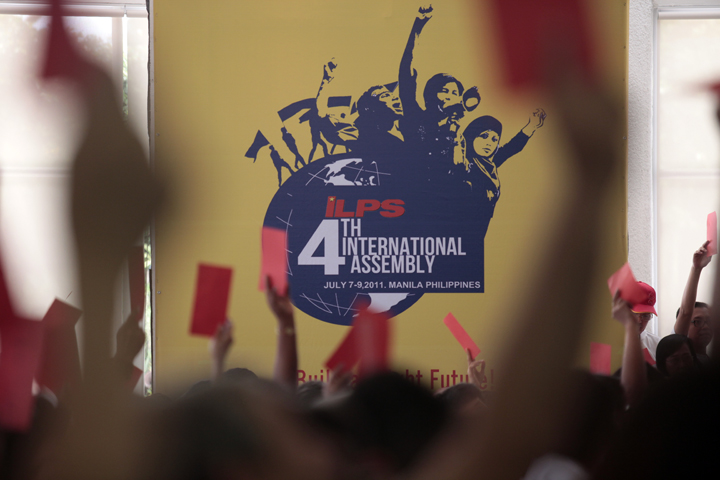
Participants of the 4th ILPS Assembly in Manila, July 2011

Finally, the International League of Peoples’ Struggle (ILPS) forms the united front for anti-imperialist and democratic struggles of workers, peasants, women, youth, professionals and other sectors of society around the world. The ILPS- USA chapter will hold its founding assembly on the third week of May 2012 in Seattle. Visit www.ilps-web.com for updates.


Why Americans Need to Stand Against Imperialism

US President Obama shakes hands with Philippine President Aquino

The current U.S. puppet, Benigno “Noynoy” Aquino III, is squandering the Filipino people’s money on senseless foreign debt servicing and fortification of the Armed Forces of the Philippines (AFP) in its U.S.-backed war against the armed resistance in the countryside without addressing the root cause of the conflict. His government, with assistance from the Obama administration, continues the cycle of indebtedness and state repression.

The U.S. granted approximately $28 million in military aid to the Philippines this year. This package includes financing, educating and training, and anti-terrorism schemes for the AFP, internationally notorious for over a thousand cases of torture, abductions, extra-judicial killings, illegal arrests, and other human rights atrocities within the past ten years.

Imperial U.S. maintains hegemony over much of the world’s resources and preserves its otherwise crumbling capitalist economy through war and occupation. At present, one can think of the developments in Libya, Iraq, Egypt and Afghanistan as its prospective hosts. In the same vein that the U.S. snatched the Philippine revolution’s victory over Spain in 1898, it is maneuvering and manipulating these territories into subservience to American products and ideals. Not surprisingly, the model of “defend, educate, rebuild, protect” that was successfully prototyped in the Philippines is now being used in these areas of imperialist interest.

U.S.- NATO Forces

To start off, the U.S. will help a country defend its people from a dictatorship by supporting the overthrow of an unpopular leader via “humanitarian intervention”. It then proceeds to “educate” the people into glorifying the U.S., mighty liberator and ally, as the state’s government and economy are revitalized by funds lent by the IMF-World Bank, rendering the weakened nation unwittingly buried in foreign debt. The local ruling class forge policies with the neo-colonizers to protect imperialist investments and promote colonial culture at the hands of a fascist government.

Our Next Steps

U.S. taxpayers should not subsidize the greed and ambition of monopoly capitalism. Instead, the trillions of dollars spent on war should be cut, and re-channeled as budget for social services like education, health care, housing, pension, etc. Building an anti-imperialist united front here in America is only possible if its citizens consciously link their domestic struggles to the global struggle against the reckless use of public resources for tyranny of one state over another.

AB-NJ with BAYAN and other allied orgs at the April 9th Anti-War Rally in NYC

Anakbayan New Jersey is inviting the youth, Filipino and non-Filipino, to: (1) work on joint campaigns to expose and oppose U.S. military presence and military aid in the Philippines and other semi-colonial countries; (2) participate in, and launch actions for, Philippine Solidarity Week in February; and (3) join the International League of Peoples’ Struggle.

Chinese revolutionary, Mao Zedong, once said, “Imperialism is nothing but a paper tiger”. By strengthening our ranks with critical education, solid organization,and collective mobilizations, we garner little victories toward loosening the intimidating grasp of imperialism over our daily lives. The youth and students in the U.S., united with the workers and other oppressed sectors across the globe, can generate a formidable force that will shake the already wavering foundation of monopoly capitalism from within, and build a better society for the next generation. ###

Filipinos in America…Silent Minority No More – NAFCON

For Immediate Release

22 August 2011

Reference: Jun Cruz, NAFCON Public Info Officer

Email: info@filipinocc.org

The National Alliance for Filipino Concerns (NAFCON) raises the hands of the four Filipino nurses:  Corina Yap, Anna Rosales, Hazel Granada, and Hachelle Natano for their collective courage in asserting their civil rights. It can be recalled that they were fired by their former employer Ben Secours Health System in Baltimore, Maryland for speaking in Tagalog as a violation of the company’s “English Only” policy.

Recently, it was determined by the US Equal Employment Opportunity, through its director Gerald Kiel, that there was reasonable cause that Ben Secours Health System subjected the nurses to “unequal terms and condition of employment, a hostile work environment, disciplinary action and discharge because of their nationalorigins (Filipino) in violation of Title VII of the Civil Rights Act of 1964 as amended.”

NAFCON Executive Vice President Rico Foz praised the Filipino nurses for their couragein asserting their right to speak our native language. Foz also thanked the Filipino community for not faltering in their support for our beleaguered kababayans. “This is Bayanihan in its very essence and spirit, another living proof that if we join hands, our collective voices are definitely heard.”

NAFCON proudly commended its legal counsel, Atty. Arnedo Valera of the Migrant Heritage Commission for pursuing this anti-labor and anti-discriminatory case to victory. “This victory is definitely a victory not only of our community but of all immigrants in the US” added Foz.

There are about four million Filipinos in the US making them the third largest immigrant population in the country, next to Mexico and China. Tagalog, a Filipino language, is the fifth most spoken in the US.

“Indeed, America is a nation of immigrants, of diversity and of multiculturalism. This landmark victory puts us in history once again. The Filipinos in America are a silent minority no more” concluded Foz. # # #


To join the NAFCON news list please send a request to info@nafconusa.org.

The National Alliance for Filipino Concerns [NAFCON] is a national multi-issue alliance of Filipino organizations and  individuals in the United States serving to protect the rights and welfare of Filipinos by fighting for social, economic, and racial justice and equality. It was launched in San Jose Californiain 2003. At present, NAFCON members encompass over 23 cities in the United States.

NAFCON Calls Community to Support Prince George’s Teachers

For Immediate Release

16 August 2011

Reference: Jun Cruz, NAFCON Public Info Officer

Email: info@filipinocc.org


The National Alliance for Filipino Concerns urges all to support the 1,044 teachers, mostly Filipino, wrongfully facing immediate deportation. According to Rico Foz, Executive Vice President of NAFCON, “The Department of Labor (DOL) is punishing these teachers even though it is the   Prince George’s County Public School (PGCPS) that is at fault.”


After DOL determined that PGCPS owed the teachers $4,000 each in back-pay, they subsequently barred the school district from employing foreign workers for two years. “As a result, 957 Filipinos lost the job they sacrificed their entire lives in the Philippines for and to make matters worse face immediate deportation,” continued Foz.


In the short term, NAFCON urges the community to sign the petition at http://www.change.org/katarungan-dc, educate others of the   Prince George’s teachers plight, and stay tuned for other ways to support.


In the long term, NAFCON believes it is imperative to further strengthen the nationwide immigrant and worker rights movement with more Filipinos willing to stand up and defend our rights and welfare. Foz concluded, “Too often Filipinos fall victim to employer exploitation and the failure of both the Philippine and   U.S.   governments’ systems to protect migrant workers. Thus we must organize so we can protect ourselves.”


In October 21-23, in   New York  , NAFCON will convene its General Assembly highlighting the theme, “Further Deepen the Unity of the U.S. Filipino Immigrant Movement to Defend our Rights and Welfare and Build a Better Future for our Homeland”. NAFCON envisions this assembly will strengthen our community’s ability to protect the   Prince George  ’s teachers and all migrant workers. ###


To join the NAFCON news list please send a request to info@nafconusa.org.


The National Alliance for Filipino Concerns [NAFCON] is a national multi-issue alliance of Filipino organizations and individuals in the United States serving to protect the rights and welfare of Filipinos by fighting for social, economic, and racial justice and equality. It was launched in San Jose California in 2003. At present, NAFCON members encompass over 23 cities in the United States.

US Anti-War Activists, Peace Advocates Gather in Manila for Historic International Conference Amidst Looming US Military Presence in Region

News Release

July 14, 2011Reference: Bernadette Ellorin, Chairperson, BAYAN USA, email: chair@bayanusa.org

4th International League of Peoples' Struggle Logo

Over 60 US-based anti-war activists composed one of the largest country delegations to the fourth international assembly of the International League of Peoples Struggle (ILPS), held last July 7-9 in San Mateo, Rizal. They were joined by over 430 delegates from East and West Asia, Oceania, Africa, Europe, Canada, Mexico, and Latin America in the largest assembly of ILPS since its founding in 2001. The assembly also marked the 10th anniversary of the global alliance of over 350 grassroots organizations and movements from over 40 countries worldwide.

Delegates from the BAYAN USA, the largest progressive Filipino-American alliance in the US, People Organized to Win Employment Rights (POWER) and Chinese Progressive Association (CPA) in San Francisco, the International Action Center, the New York May 1st Coalition, and the Black Agenda Report were in attendance and participated in the various plenary and workshop sessions of the assembly that tackled issues such  as US military aggression, US foreign military bases and operations, US-funded counter-insurgency operations, as well as worldwide struggles of workers, migrants, farmers, women, youth, and indigenous peoples in the face of neoliberal policies and continuing foreign economic intervention.

In addition to opposing ongoing US military aggression in in West Asia and North Africa, the assembly also united strongly in support several national movements asserting sovereignty against US domination and intervention, namely US-Israeli occupied Palestine, the Philippines, as well as progressive governments in Latin America such as that of Venezuelan President Hugo Chavez.

Rosa Martha Zarate Macias of Mexico sings to the assembly

Mexican singer-songwriter and migrant rights organizer Rosa Marta Zarate-Macias described the large gathering as “encountering a family I have chosen to be a part of. I came all the way from Mexico to the Philippines, only to find out that the struggles of people here in Asia and in Africa are the same as in Latin America. This gathering opened my eyes to our common struggle and our common adversary– the few wealthy families in our countries that serve the interest of the corporations and enslave the rest of the people.”

Kuusela Hilo of BAYAN USA

Kuusela Hilo, Vice-Chairperson of BAYAN USA and newly-elected member to the International Coordinating Committee (ICC), the lead body of the ILPS, stated, “The worsening global economic crisis continues to drive the intensification of the profit-driven US military-industrial complex, at the human cost of the peoples of the world, including the American people. The growing unrest in the US over deadly budget cuts on education, health care, as well as rising unemployment and joblessness must link with similar struggles abroad in order to effectively shake the current system and facilitate change. The ILPS can certainly be maximized as a global coordinating body to realize this.”

Bill Doares of the International Action Center speaks

Hilo joins newly-elected ILPS Vice-Chairperson of External Affairs Bill Doares of the International Action Center and newly-elected ILPS Auditor Lyn Meza of Chelsea Uniting Against the War in Massachusetts in the ICC.

Key international campaigns adopted during the international assembly were also taken up by several US delegates, including a global campaign to dismantle the US foreign military bases and operations in over 700 posts worldwide.

In addition, San Francisco-based hip-hop performers Power Struggle, Seattle hip-hop MC Rogue Pinay, and acoustic acts Taospuso joined performers from Palestine, the Philippines, and Taiwan in a crowd-pleasing solidarity night and even performed throughout the assembly itself.

ILPS 4th International Assembly plenary session

Delegates from the United States also committed to building a US country chapter of ILPS by next year. A country chapter in Canada was recently launched earlier this year, joining the roster of ILPS country chapters in Australia, Hong Kong, Macau, and Indonesia.

Earlier in the week, US missile ships dropped anchor in the South China Sea to engage the Philippine Navy in joint military exercises under the US-RP Mutual Defense Treaty. The unpopular presence of the US military in close proximity to the Spratly Islands has moved international groups to protest the exercises as a maneuver to take advantage of the territorial dispute to provoke US-directed military aggression against rival superpower China and in the region. ###